
A page of FAQs on the promotional industry. Including various terms and acronyms frequently used in the space and what they mean. This article will explain promotional concepts. Watch this space for updates.

Last updated: 18/03/2026
Alongside various definitions, there are many facets in running promotions and many, sometimes confusing, concepts and terminologies to wrap your mind around when it comes to the promotional space. It's often a word used to refer to price promotions and price discounts. In our world, it means a brand promotion, a value-add promotion. A marketing tactic that drives a shopper to consider a product and buy it, without needing to reduce the product's price.
We want to make brand promotions more understood and accessible to SMEs, and a frequent hurdle in understanding is the terminology used in the space. This is why we’ve created this FAQs page on brand promotions to keep as a handy reference and glossary to key terms, concepts, and commonly referred to topics in the industry. We’ve linked a few of our articles and helpful resources throughout this blog, which will provide more in-depth information and insights into specific aspects of brand promotions.
A marketing approach that focuses on understanding shoppers and their behaviour and then using this knowledge to create a marketing mix that influences shoppers to consider a certain category, consider a certain brand and to purchase a product.
Activation is a broad categorical term used to describe campaigns, experiences, and events that can generate awareness and also trial for a brand.
Marketing strategies used to enhance brand awareness and image. While a rather broad term, the core of brand promotions is that it focuses on spotlighting the brand rather than the price of it.
A prize promotion is a promotional technique which typically involves a value add-on for a brand in exchange for a form of brand engagement. Prize promotions can have multiple mechanics; for example, instant wins, prize draws, and gifts with purchases. Consumers may get the chance to win or earn prizes after meeting certain eligibility criteria and completing certain actions set out by the brand. Some actions may include purchasing a product, visiting a microsite, completing an entry form, uploading a receipt, etc.
A price discount on goods.
A promotional mechanic refers to the format in which a prize promotion is delivered. The mechanic will dictate how a winner is chosen, how and which participants can enter, and how prizes or gifts are received.
The term 'prize draw' encompasses several promotional mechanics, but traditionally, prize draws are a type of prize promotion where a winner is chosen at random from all valid entries that the participants submit.
An instant win is a type of prize promotion mechanic where the participant knows instantly if they've won something.
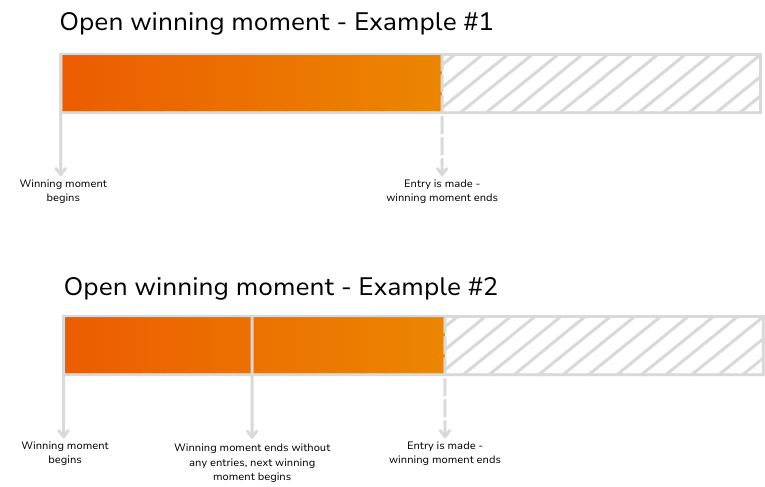
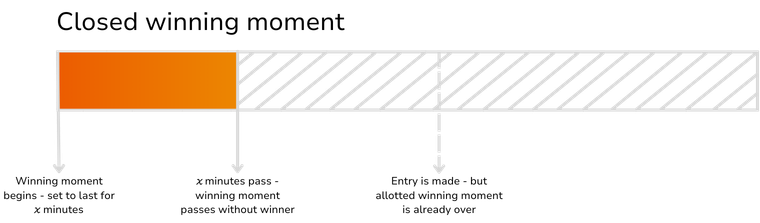
Winning moments are set periods within an instant win where participants can win a prize. This period is not known to participants and is often randomly decided to ensure fairness in the promotion.
This is a type of winning moment where it does not end and remains open until either:
This is a type of winning moment that has a set start and end point. This means if no participants enter within that time frame, the prize for that winning moment is not awarded.
Prize draws and instant wins are chance-based, so all winners are selected at random.
Meanwhile, competitions are judged, which makes them skill-based. Competition winners are chosen based on their ability or knowledge. For example, a competition could be based on questions, so only those who are able to answer them would be eligible to win a prize. A competition could also be a photo/costume contest; this may be based on the number of likes a social media post has but could also be judged by a preselected panel.
Text-to-win promotions involve participants sending a certain message, usually including some personal information to a specific number which will enter them into the promotion.
When brands or retailers offer a free item upon buying a product or spending a certain amount.
This is a promotion to attract customers and increase the average value of an order. The free gift can come with the purchase in-store or can be redeemed online.
MONP stands for 'money off next purchase'; it’s usually in the form of an e-voucher or coupon, and it can be an engaging mechanic to attract attention in-store.
Meaning 'Secure File Transfer Protocol', it is a client-server protocol. It is a secure way to transfer files between computers over a network. The data is encrypted during transmission and is commonly used to securely share files.
The ASA, or the 'Advertising Standards Authority', is the UK's self-regulatory body on advertising, they enforce UK media to the advertising codes known as the CAP codes
CAP stands for ‘The Committee of Advertising Practice’. The CAP codes are regulations for advertisements, sales promotions, and direct marketing communications.
A website separate from a brand’s primary site, which hones in on one specific aspect of a brand rather than an overview of everything. This could be various things, but most commonly, microsites are used to spotlight specific products, services, or promotional campaigns
Adobe XD is a vector-based web and mobile design application which was made to help design UX, UI and wireframes for various platforms and applications.
Also known as 'liquid layout', fluid responsive is when websites are built using percentages for widths. This allows browsers to scale up and down columns fluidly as they're relative to each other.
A promotion where customers can refund their purchase by showing proof of purchase.
An upfront fee paid by a brand to transfer the risk of an idea/promotion to an agency that calculates the costs of consumer redemption, protecting the promoter from the possibility of unexpected redemption rates on activations like ‘Try Me Free’ promotions.
An additional offering, like a competition or savings voucher, which is advertised on the packaging of a product.
CPG (consumer packaged goods) is a term to describe products that sell fast, and those which consumers buy often, almost every day.
FMCG (fast-moving consumer goods) is a term to describe products which sell fast and are bought by consumers every day. FMCG is a more specific term to describe products that sell very quickly in the CPG industry.
'Always on' refers to campaigns that are run continuously year-round. This kind of marketing focuses more on building awareness than other metrics or conversions, which typically are the focus of campaign marketing, which is often seen as the opposite of always-on marketing.
In promotions, 'always on' usually refers to a promotional platform, website, or microsite that is always live and usually with some form of brand promotion available.
POP stands for proof of purchase, required by participants in purchase-necessary promotions to validate their entry as eligible. Proof of purchase may take many forms, including receipts, invoices, unique codes, etc.
URNs, or unique reference numbers, are codes that participants can use in place of a receipt as proof of purchase or proof of identity when entering promotions. This code may be sent as an OTP or printed on packaging as part of an on-pack promotion.
Connected packaging is product packaging that includes a direct route to a digital experience. Often used to facilitate brand engagement via mobile phone and internet access. Common methods include QR codes, RFID, and NFC chips.
Please note: the following part of the article is a version written 04/12/2023 by Abigail Hickey, previously titled "Answering Some Frequently Asked Questions"
What is a promotional campaign?
A promotional campaign is a strategic effort to promote a product, service, or brand to a targeted audience. It involves a series of coordinated activities and messages designed to increase visibility, generate interest, and ultimately drive action. These campaigns typically utilise various marketing channels such as advertising, public relations, social media, and sales promotions to reach and engage with the intended audience. The primary goal is to communicate the value proposition of the offering, differentiate it from competitors, and persuade consumers to make a purchase or take a specific action, often through creative content, incentives, and effective communication strategies - all helping to increase valuable long-term brand equity.
Why use a promotional campaign?
Promotional campaigns serve several crucial purposes in the business landscape. Firstly, they raise awareness about a product, service, or brand, ensuring that the target audience knows about its existence, benefits, and unique selling points. These campaigns also aim to generate interest and create a favourable perception among consumers, ultimately driving engagement and sales. Moreover, they can help a company differentiate itself from competitors by highlighting its strengths and value propositions. Additionally, promotional campaigns can be instrumental in building and fostering customer relationships, leading to brand loyalty and repeat business. These campaigns are strategic tools businesses employ to increase visibility, attract customers, and ultimately boost revenue and market share.
Where to advertise a campaign?
We may be biased but in our opinion, on-pack promotions are the best way to effectively advertise through various channels to maximise their impact and reach. Leveraging the packaging itself as the primary platform, companies can prominently display these promotions on product labels, boxes, or containers. Simultaneously, using digital channels like social media platforms, websites, and email marketing can enhance the visibility and engagement with the on-pack promotions. Creating targeted ads on social media that showcase the promotion or incorporating it into email newsletters can effectively reach a wider audience beyond just those interacting with the physical product. Additionally, collaborating with retail partners to display the promotion in-store through signage or shelf displays can further reinforce the message and attract potential customers at the point of purchase. Integrating these strategies creates a multi-channel approach that maximises the visibility and impact of on-pack promotions.
In short, on-pack promotions reinforce both brand and pack recognition, crucial in shopper marketing.
What is interactive marketing?
Interactive marketing is a dynamic approach to digital promotions that engages consumers directly through quizzes, polls, contests, and immersive experiences such as AR and VR. It fosters two-way communication, encouraging active participation and personalised content creation. This strategy aims to create memorable brand experiences, gather valuable insights, and encourage consumer engagement.
Are campaigns marketing?
Yes, campaigns are a crucial aspect of marketing. Marketing involves various strategies and activities aimed at promoting products, services, or brands to targeted audiences. Campaigns, in this context, refer to focused, organised efforts within marketing. They are structured initiatives with specific objectives, utilising various marketing channels and tactics to achieve set goals. Campaigns can encompass a range of activities, such as advertising, public relations, content creation, and promotional efforts, all working together to convey a cohesive message and drive desired outcomes, like increased brand awareness, sales, or customer engagement.
How to get the most out of a promotion?
To get the most out of a promotion, consider incorporating these strategies:
1. Clear Objectives
Define specific, measurable goals for the promotion. Whether it's increasing sales, boosting brand awareness, or gaining new customers, clarity in objectives helps tailor the promotion for success.
2. Targeted Audience
Understand your audience’s demographics thoroughly. Tailor the promotion to resonate with their needs, preferences, and behaviours. Personalisation enhances engagement and conversion rates.
3. Compelling Offer
Create an irresistible offer, prize or incentive. Whether it's a discount, limited-time offer, exclusive access, or bundled deals, the value proposition should be compelling enough to drive action.
4. Omni-Channel Approach
Utilise various marketing channels to reach a wider audience. For maximum visibility, combine social media, email marketing, influencer collaborations, and in-store promotions. The user journey extends over multiple channels and so, brands must engage these channels as appropriate.
5. Timing
Timing is critical. Launch the promotion when your audience is most active or during peak buying times. Consider seasonal trends or holidays that align with your offer.
6. Tracking and Analytics
Implement tracking mechanisms to measure the promotion's performance. Analyse data to understand what works, informing and enabling you to optimise future promotions.
7. Clear Communication
Ensure messaging is clear, consistent, and aligned across all channels. Highlight the benefits of the promotion and the urgency to act.
8. Customer Experience
Focus on providing a seamless customer experience. From the first interaction to purchase and post-purchase follow-ups; including careful winner management. Ensures a positive experience to encourage repeat customers.
9. Feedback and Adaptation
Gather feedback during and after the promotion. Adapt strategies based on insights gathered to improve future promotions.
10. Follow-Up
Engage with customers post-promotion. Thank them, request feedback, or offer incentives for future purchases, fostering continued engagement and loyalty.
By combining these strategies and continuously refining your approach based on data and feedback, you can optimise promotions to achieve the best possible results.


We’re happy to answer any of your questions or to tell you more about what we do and how we could support your next promotional campaign.


Enter your telephone number below and one of our UK-based experts will call you back immediately.
