
Cornering in on debate over the use of the word 'promotion' as a noun, bundling of price and brand promotions, and how the sector is going to change that
Originally published: 24/01/2024, updated: 12/03/2026.
Contents:
“Price promotions build loyalty."
“Price promotions attract new consumers.”
“Price promotions encourage customers to spend more."
“Price discounts improve long-term profitability."
“Brands benefit the most from price promotions."
How do you effectively use price promotions?
Coming up with solutions and next steps
Brand promotions vs. price promotions
'Promotion' is an umbrella term for any marketing activity done by a brand to increase brand awareness, boost sales, and attract consumers.
There’s an ongoing debate within the industry about the word 'promotions', with the term being used in radically different contexts; it doesn't always convey the right kind of promotional activity that marketers intend. However, price promotions are likely what people think of when thinking about 'promotions', which refers to a price discount on goods.
While price promotions are easy for brands to execute and can sometimes provide a quick boost to your brand, there are many myths surrounding the effectiveness of price promotions for brands in both their long-term and short-term profitability. In this article, we’ll go through various common assumptions about price promotions.
Perpetuated by the idea that lowering the price will encourage purchase and turn new customers into loyalists, this myth is misleading. In isolation, price promotions do not build loyalty in a meaningful way, nor do they usually attract new customers.
In fact, most sales during a promotional period are from existing customers: 50-60% of promotional volume comes from frequent buyers, 20-30% from semi-frequent buyers, and 5-10% from new/non-buying households. Non-category and light-category buyers are far less responsive to price promotions than regular customers, and even though it may translate into trials for your brand, it rarely translates into deeper loyalty.
For example, if you're doing your weekly shop in Tesco and a packet of McVities Chocolate Digestives is a staple, do you even look at the price before adding a pack to your trolley?
The idea behind this statement is that price discounts encourage shoppers to buy, under the assumption that price is the main barrier for shoppers. In certain cases, price discounts can be helpful as temporary penetrative pricing, but there’s nuance.
For national and established brands, there’s unlikely to be any long-term benefits in running a price promotion. However, for private-label and store-brand goods that are lesser known or new, a price promotion can be a good tool to consider. It’s not necessarily the price promotion that attracts customers, but rather trials from the discount leading to ’stickiness’ and retention if the customer deems a new product as good enough to continue using or to replace their usual brand with.
Although, as a whole, brands should remember that price promotions usually just attract deal-seekers rather than loyal customers, which ultimately is the long-term concern, making them the least risky for new brands and products being introduced to a new audience.
While it’s true that customers tend to bulk buy when there is a promotion, a ‘forward-buying’ effect , also referred to as 'pantry-loading', takes place.
By running a price promotion, brands borrow from future demand, which means following an artificially inflated surge in sales, the promotion often sees a dip in sales afterwards to compensate. To account for this, brands and marketers should isolate their baseline sales in order to avoid risking the misinterpretation of the promotion showing incremental growth.
It’s easy for brands to fall into the sale doom loop as “buy-only-on-sale” behaviour is reinforced, conditioning consumers to wait to buy something on sale rather than at the full price.
The sale price cannibalises itself, and it’s difficult to return to the original price of the product, leaving brands constantly stuck putting price discounts on their products and eroding their profit margins.
In the study, Pauwels, K., Hanssens, D. M., & Siddarth, S. (2002), investigated the long-term effects that price promotion had on “category incidents", which included how many people bought in the category at all, brand choice, and purchase quantity. These observations took place on two product types, yoghurt (bought frequently and highly perishable) and soup (which is usually bought in bulk and is a longer-term purchase in comparison to yoghurt). What the study found was that the factor with the most long-standing effect was how many people bought in the category.
Price discounts encouraged people to buy more from the category, but not necessarily from one brand. This means retailers will benefit more from price promotions as a result than the brand in the long term – especially if they want to drive more sales in certain categories.
Price promotions should be applied tactically and work best when used in conjunction with campaigns with wide distribution, which lays a strong foundation for long-term growth. The price promotion itself is a strong call to action and can funnel consumer attention to wider brand campaigns.
The discount shouldn’t be the brand; rather, it should be used as a supporting tactic. Price promotions improve the “mental accessibility” of the product to consumers, which provides a chance to accelerate purchase volume when it successfully aligns with a brand’s broader objectives.
Now that we’ve established that price promotions may not be the best marketing tactic that brands can apply in isolation, what now? While it’s important to understand why something doesn’t work or to break down misconceptions, it’s also important for us to provide solutions and alternatives rather than just the issue itself.
So what can a brand offer outside of price discounts? And what does an ‘offer’ mean to you as a marketer? While a discount on a product is something a brand needs to budget for as an offer, an offer can also mean adding free or low-cost additions such as a free quote or free shipping, which still provides value to customers but is either free or works out cheaper than a price discount.
Value does not always relate to price, and they can be seen as two factors to balance in an offer. Whenever value exceeds price, customers will be more receptive to the offer – the greater the worth placed on the product offering, the more comfortable people will be paying for it.
Adding value can be just as effective as small discounts (with a discount value of around 5% - 20%) when it comes to customer satisfaction without the long-term repercussions of a price discount.
Adding value is an opportunity for many benefits:
How can your brand add value? There are many ways, but a few examples include sizing up orders, extended warranties and customer support, prize promotions, free shipping and lowered fees such as postage and delivery, etc.
Consumers respond better to exclusive offers, sales, and discounts if they are personalised and well-targeted. For example, instead of offering discounts at retailers, if offers are sent to existing customers or newsletter subscribers, it feels more like the brand acknowledging and thanking their customers, improving loyalty and the impression towards the brand. It also creates an “in-group”, fostering a sense of exclusivity.
Personalisation makes customers feel valued and seen, driving deeper connections with the brand. Brand can use data to craft personalised recommendations, birthday offers, or special deals based on past purchases.
A brand promotion refers to marketing strategies used to build and enhance brand awareness and image. There are many types, which we will go over in the following sections below. While a rather broad term, the core of brand promotions is that it focuses on spotlighting the brand rather than the price of it.
Brand promotions can spotlight your brand with experiential value and incentivise purchase without having to reduce a brand’s product, revenue or margin. These promotions are distinct from price promotions, raising the public profile of a product whilst increasing long-term value without cheapening the brand image.
Prize promotions is a broader categorisation for a sector of the marketing industry with many mechanics and techniques.
“A prize promotion is a promotional technique which typically involves a value add-on for a brand in exchange for a form of brand engagement. Prize promotions can have multiple mechanics; for example, instant wins, prize draws, and gifts with purchases. Consumers may get the chance to win or earn prizes after meeting certain eligibility criteria and completing certain actions set out by the brand. Some actions may include purchasing a product, visiting a microsite, completing an entry form, uploading a receipt, etc.”
– PromoNow, Answering FAQs About Brand & Prize Promotions
Prize promotions are a great way to attract new customers and build brand awareness, encouraging customers to take part and engage with the brand. It’s also an opportunity for exposure, as 62% of promotional participants reported that they share the promotion with a friend to suggest that they take part too.
A strategic collaborative agreement with another brand needs to be carefully considered. Brands need to make sure when choosing a partnership, the partner brand is aligned in terms of values with your own – this will give your brand the best chance of having a successful partnership. If you’re confused as to what constitutes a good partner, you can consult this guide.
With the right brand, celebrity, sportsperson/athlete, or influencer a partnership is an opportunity for exposure to a new and highly relevant audience. Trust is built in through the public association, and it helps boost awareness and authority as the partnership provides a mutual stamp of approval to respective audiences. This method drives conversions without having to compromise on value or price.
Whether it’s in-store or online, brands can enhance the shopping experience for consumers with interactive and engaging activations.
If your brand is looking to attract new customers or if your brand is launching a new product, sampling may be a great way to do this. Brands can send out samples with a purchase or offer an in-store sampling experience to allow shoppers a memorable trial before committing to purchasing. However, sampling can always backfire in the scenario that the product sample is poor quality.
Building an exclusive loyalty programme cultivates your brand’s long-term relationships with your customers. It incentivises purchase, fosters exclusivity, and motivates continual engagement with the brand in the short term. In the long term, loyalty programmes can enhance retention, build lifetime value, and improve your brand’s positioning as a trusted market choice.
This method rewards customers for their loyalty with discounts but can also be used to maintain a premium image whilst utilising offers to encourage sales.
Brands can implement many variations of a loyalty programme; here are a few ideas, for example:
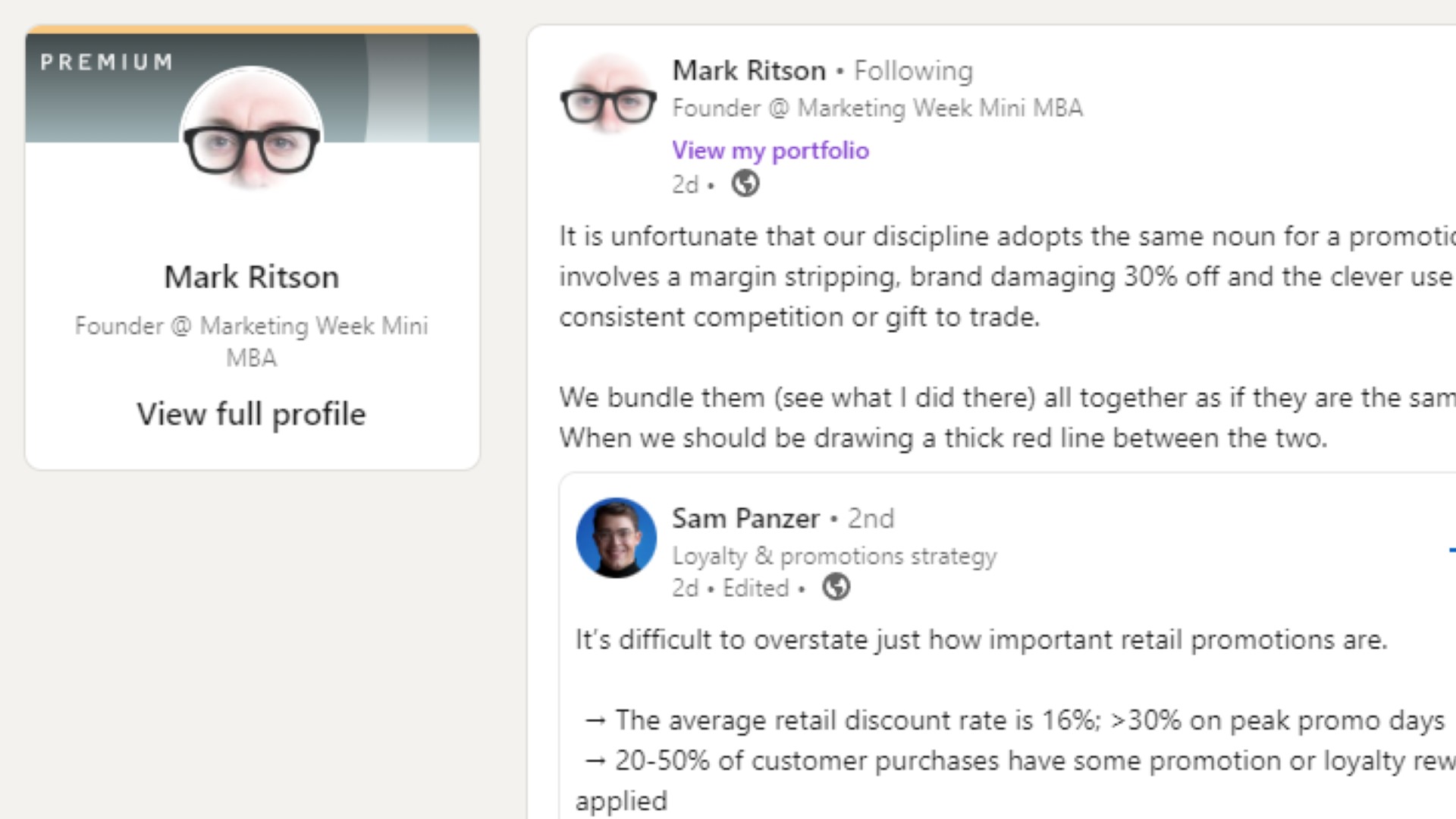
In the post that inspired this article, Mark Ritson ignited debate over the bland widespread use of the word 'promotion' as a noun, which unhelpfully bundles price promotions together with brand promotions. It’s important to draw a distinction between these two types of promotions to allow for meaningful and critical discussions.
As we’ve discussed, value added doesn’t mean price discounted – an attractive offer doesn’t always have to be a price promotion, and they achieve different goals and should be seen as distinct from one another rather than being both labelled as just ‘promotions’.
Brand promotions put the emphasis on the brand itself with campaigns and activations that build awareness and engagement and long-term benefits, whereas price promotions focus on discounts on products, which involve short-term benefits and eventual margin decay.
Promotions Interactive is an agency that helps you deliver digital for promotional campaigns.
Need help with building digital from a partner agency that works with some of the biggest brands and promotional agencies in the UK? Get in contact with us for a free chat: call us at +44 (0) 203 80 555 36 or email us at hello@promotionsinteractive.com


We’re happy to answer any of your questions or to tell you more about what we do and how we could support your next promotional campaign.


Enter your telephone number below and one of our UK-based experts will call you back immediately.
